Article
Many Organizations Accidentally Train People to Stop Thinking
• Leadership, Agile, Organizational Culture, Autonomy, Innovation, Psychological Safety, Systems Thinking
-f58c1330.jpg)
Matthias Orgler, M.Sc.
Agile Coach
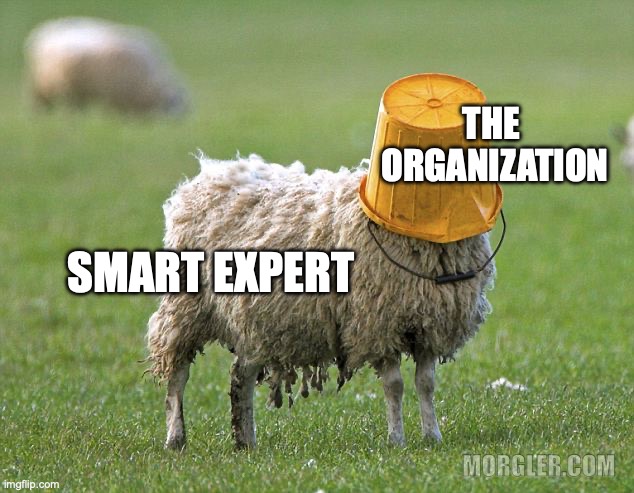
Many organizations accidentally train people to stop thinking. Not intentionally.
Most leaders I meet genuinely want motivated, proactive, innovative people. They want teams that take ownership. Teams that think ahead. Teams that solve problems without constantly escalating everything up the hierarchy.
But then I watch what actually happens inside the organization, and very often, the system rewards the exact opposite behavior.
They Thought Everyone Already Knew the Goal
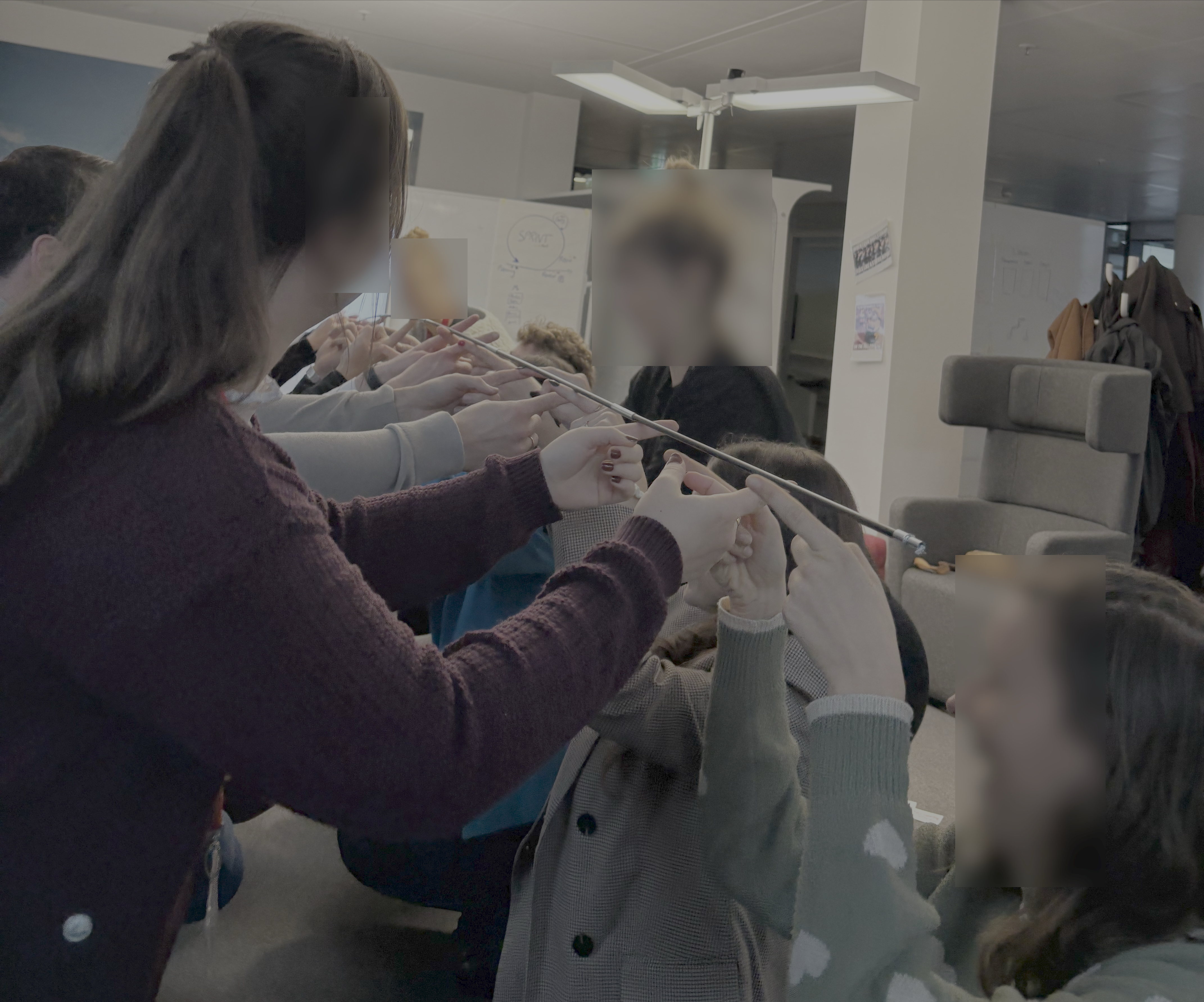
A few weeks ago, I ran one of our workshop exercises with a group of leaders and teams. The setup was intentionally simple. Four or five people. A small hierarchy. One person in a leadership role. The communication channel was simulated email via Post-it notes because, frankly, that already feels painfully realistic in many companies.
The task itself was easy.
Absurdly easy.
And yet most teams failed to complete it within ten minutes.
The leader immediately started doing what many leaders instinctively do: breaking the work into tasks and handing out instructions. Nobody shared the actual goal.
What fascinated me was that the leaders usually didn’t consciously withhold it. After the exercise, they almost always said the same thing:
“I thought everyone already knew the goal.”
Meanwhile, the people lower in the hierarchy rarely asked what the goal actually was. They simply waited for instructions and executed them as cleanly as possible.
Even Successful Teams Felt Miserable
After the exercise, we asked everybody to write down how they felt during the simulation.
The words were surprisingly emotional for such a small exercise: disconnected, frustrated, confused, lost, useless.
Even when teams successfully complete the task, they still feel frustrated, disconnected, and useless.
That should make every leader uncomfortable because many organizations confuse successful task execution with healthy organizational behavior. They are not the same thing.
When we later asked the teams how the exercise would have gone if they had simply sat together in a circle and talked openly, most groups laughed and said something like:
“We probably would have solved it in under a minute.”
Instead, they spent ten minutes routing tiny pieces of information through an artificial hierarchy while nobody really understood the bigger picture.
That is not just a workshop dynamic. That is daily life in many organizations.
Stop Asking.
And over time, people adapt to it. Not because they are lazy, lack intelligence, or don’t care. They adapt because the organization slowly teaches them what is safe.
In many companies, asking questions is socially risky.
Especially questions like:
- “What problem are we actually trying to solve?”
- “Why are we doing it this way?”
- “I don’t understand the goal.”
- “Wouldn’t there be a simpler approach?”
New employees still ask those questions sometimes. That’s one of the reasons new hires can be so valuable. They still see the absurdities everyone else stopped noticing years ago.
How does the organization react?
A healthy reaction sounds like this:
“Glad you asked. Thank you for giving me the opportunity to explain it again.”
“Glad you asked. Thank you for giving me the opportunity to explain it again.”
But many people experience something very different:
“I already explained this ten times.”
“You still don’t understand?”
“Why are you making this difficult?”
“I already explained this ten times.”
“You still don’t understand?”
“Why are you making this difficult?”
And after enough experiences like that, people learn something dangerous: stop asking.
Protect yourself. Do the task. Avoid embarrassment, conflict, and risk.
That is how learned helplessness develops inside organizations. Not through one catastrophic moment, but through thousands of tiny interactions.
I once worked with a company that proudly presented its product vision during a large planning event.
The vision was spread across something like twelve or thirteen PowerPoint slides filled with dense text, tiny fonts, multiple columns, diagrams, strategic themes, priorities, principles, and several different “North Stars.”
They Had Five North Stars
They had five North Stars.
There are many stars in the sky. The whole point of a guiding star is that there is one.
After the presentation, I asked the room a simple question: “Can somebody explain the actual product goal?”
Awkward silence. Some chuckled nervously.
A few people repeated fragments from different slides that resonated with their own department or initiative.
One person later told me:
“You are new. You don’t ask these questions here.”
That sentence stayed with me because it explained far more about the company than the PowerPoint slides ever did.
The problem was not intelligence. The room was full of highly capable people. The problem was that nobody shared a clear enough goal for autonomous thinking to become possible.
So people defaulted to tasks.
Just tell me what to do. Close the ticket. Finish the feature. Hit the metric. Attend the meeting. Move the PowerPoint forward.
People still showed up, still worked, still produced output. But the thinking was slowly disappearing.
You Don’t Get Their Full Brain Anymore
That becomes incredibly expensive. Some companies already feel this through employee churn. In highly specialized environments, replacing a single experienced employee can easily cost hundreds of thousands of euros once you factor in hiring, onboarding, lost momentum, and the time it takes until somebody becomes fully effective.
But in some ways, churn is the healthier outcome. At least churn is visible.
Far more dangerous are the people who stay. The ones who quietly disconnect.
They attend meetings, close tickets, hit output metrics, but they no longer bring initiative, curiosity, or challenge into the system.
You don’t get their full brain anymore.
And this becomes fatal in fast-moving environments because the organization also slows itself down structurally.
Wait for Instructions
I frequently see teams identify a reasonable solution quickly, only to say: “We need management approval first.”
So information travels upward through layers of abstraction until somebody far away from the actual work makes a decision with less context than the people who originally discovered the problem.
Then the decision travels back down.
Usually slower. Often worse.
David Marquet describes this dynamic brilliantly in Turn the Ship Around! as “push information to authority” versus “push authority to information.”
And once you see it, you start noticing it everywhere.
They Don’t Even Notice the Instinctive Behavior
The irony is that most leaders do not create these systems maliciously. Quite the opposite.
Most leaders are trapped inside the same system themselves. They are evaluated on predictability, punished for failure, rewarded for control, overloaded with responsibility, and conditioned to reduce uncertainty wherever possible.
So they instinctively centralize decisions, over-specify tasks, rescue people from ambiguity, and treat questions as signs of confusion instead of engagement.
They don’t even notice the instinctive behavior.
And over time, the organization slowly trains people that independent thinking is exhausting, risky, or pointless.
They are accidentally training it out of people.
One approval chain at a time.
One punished experiment at a time.
One missing goal at a time.
One humiliating meeting at a time.
One punished experiment at a time.
One missing goal at a time.
One humiliating meeting at a time.
Until smart people stop thinking.
I once saw a product owner try a new technical approach that initially looked promising. The idea failed during integration and caused problems.
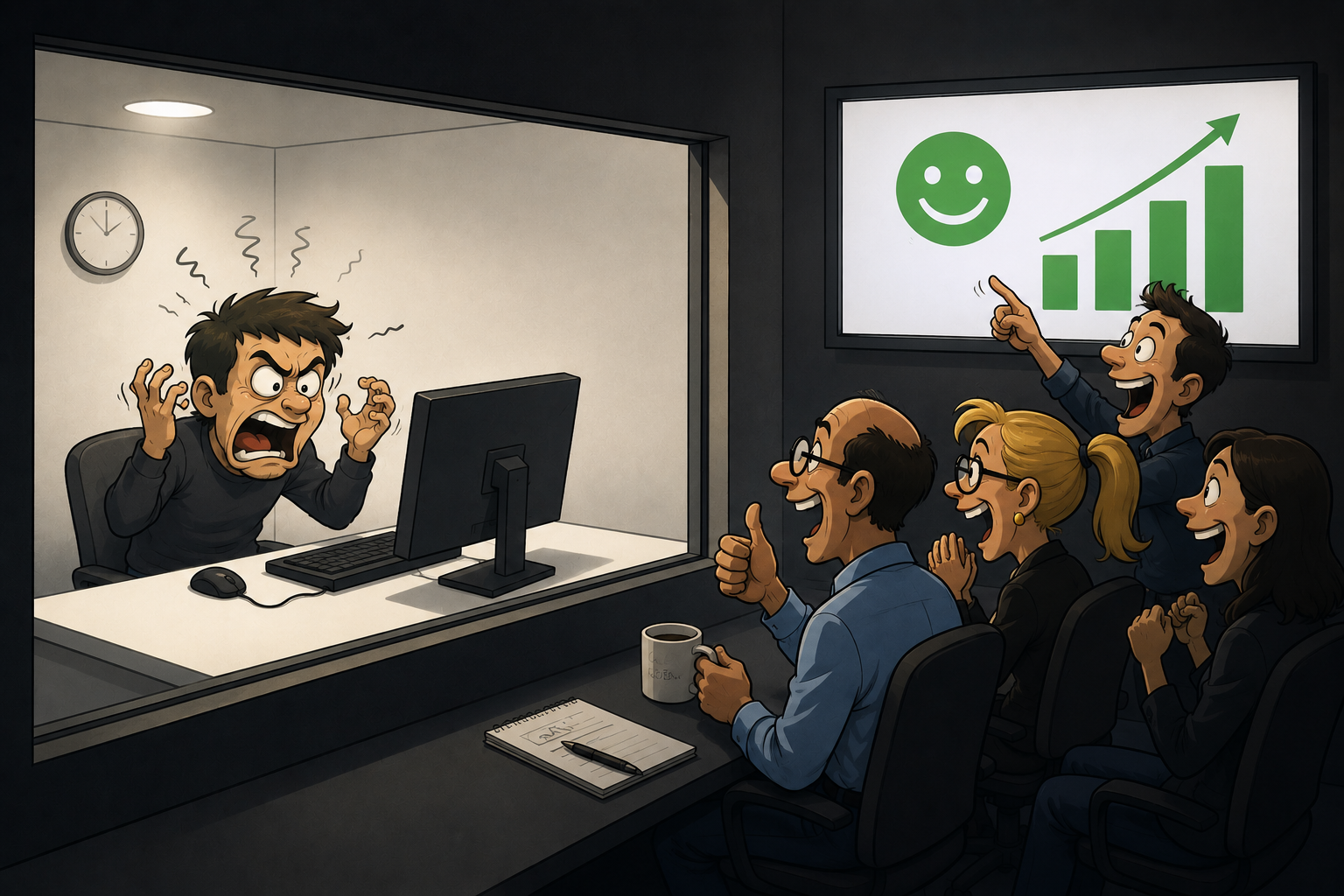
The response from leadership was brutal. The boss publicly screamed at the product owner in front of more than a hundred people and humiliated them for making such a “stupid mistake” without escalating the decision first.
Afterward, that person stopped experimenting completely. And honestly, that reaction was perfectly rational.
The organization had just taught them the real lesson:
Do not think independently.
Wait for instructions.
Wait for instructions.
This is why so many organizations simultaneously claim they want innovation while systematically punishing the behavior innovation requires.
Because innovation requires:
- experimentation
- ambiguity
- incomplete information
- initiative
- dissent
- mistakes
- uncomfortable questions
But many systems operationally reward:
- predictability
- obedience
- local optimization
- risk avoidance
- task completion
- appearing competent
Those two worlds collide every day inside modern companies, especially in knowledge work.
Organizations spend enormous amounts of money hiring intelligent people and then build systems where independent thinking becomes undesirable.
That is not just a culture problem. It is a strategic problem.
Because markets move, technology changes, customer expectations shift, and competitors adapt. Organizations where every meaningful decision has to crawl upward through the hierarchy eventually become too slow to learn.
One Interaction at a Time
The encouraging part is that this behavior becomes visible very quickly once people experience it directly.
That is why these workshop exercises are so powerful.
People suddenly feel the disconnect. They feel the slowness. They feel the confusion. They notice the assumptions. They see how quickly initiative disappears when goals, trust, and decision-making authority are missing.
And once people truly see the pattern, many of the behaviors start changing surprisingly fast.
Most of these behaviors are deeply ingrained instincts.
Leaders instinctively jump into task assignment instead of sharing context. Employees instinctively wait for instructions instead of asking questions. Organizations instinctively centralize decisions whenever pressure rises.
The system pulls people back into old patterns constantly.
That’s why real change requires more than understanding.
It requires practice. Repetition. Deliberately building new reflexes.
But once people can finally see the pattern, they start catching themselves in the moment.
“Wait. Did I just give instructions instead of sharing the goal?”
“Did we just create another approval bottleneck?”
“Did I just punish initiative?”
That’s where cultural change actually begins. One interaction at a time.
Subscribe to The Agile Compass
Weekly articles, special offers, and a chance to interact with me via email. No spam. Unsubscribe anytime.
- Weekly articles
- The Agile Compass delivers fresh insights each week.
- No spam
- Unsubscribe anytime. We only send valuable content.