
Article
Most Companies Don’t Want Feedback. They Want Confirmation.
• Agile, Leadership, Innovation, Product Development, Scrum, Psychology, Experimentation, Learning
-f58c1330.jpg)
Matthias Orgler, M.Sc.
Agile Coach

Most organizations say they value experimentation, innovation, customer feedback, and learning.
But if you observe what actually happens inside many companies, something very different emerges. Teams avoid showing unfinished ideas. Product managers steer customer conversations toward reassurance. Executives selectively focus on metrics that support the current strategy. Sprint Reviews become polished demo sessions where risky assumptions quietly disappear before anyone important sees them.
Nobody explicitly says:
“Let’s avoid learning.”
“Let’s avoid learning.”
But that is often exactly what happens.
Because learning is uncomfortable, especially when learning means admitting that our assumptions might be wrong. And the really dangerous part is that this often doesn’t feel irrational at all. It feels responsible. Professional. Strategic. Nobody wants to embarrass their team in front of stakeholders. Nobody wants to propose an idea that customers might reject. Nobody wants to tell leadership that the expensive initiative they approved six months ago might not actually solve the problem.
You can even observe this tendency in one of the most famous psychological experiments on confirmation bias.
In Peter Wason’s “2-4-6” experiment from the 1960s, participants are told that the sequence “2, 4, 6” follows a hidden rule. Their task is to discover the rule by proposing additional number sequences. The facilitator simply tells them whether their proposed sequences match the rule or not.
Most people immediately start proposing things like:
“4, 6, 8”
“10, 12, 14”
“20, 22, 24”
“4, 6, 8”
“10, 12, 14”
“20, 22, 24”
And when they hear:
“Yes, that matches the rule,”
they become increasingly confident they understand the pattern.
“Yes, that matches the rule,”
they become increasingly confident they understand the pattern.
But what they are actually doing is seeking confirmation. They are testing examples that fit their current assumption instead of trying to invalidate it.
Very few people try:
“3, 5, 20”
or
“10, 11, 200.”
“3, 5, 20”
or
“10, 11, 200.”
Even fewer deliberately try something they think will fail.
The irony is that the fastest way to discover the actual rule is not to search for confirmation. It is to aggressively search for where your assumption breaks.
Hold on to that sequence for a moment. We’ll come back to it.
And this is precisely where organizations struggle.
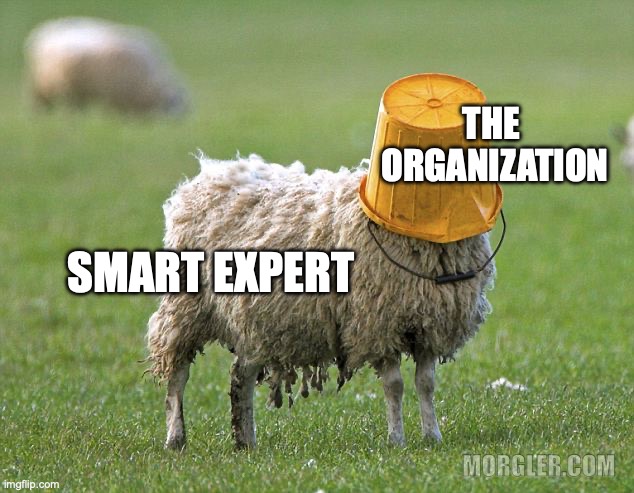
Because once status, reputation, budgets, promotions, politics, and performance evaluations enter the picture, invalidating assumptions becomes emotionally expensive. People start protecting themselves instead of challenging their thinking. They avoid the customer question whose answer might hurt. They avoid the Sprint Review moment that might expose an uncomfortable assumption. They avoid the experiment that could prove the roadmap wrong.
This is also where psychological safety becomes incredibly important — and often misunderstood.
Psychological safety is not about avoiding failure, criticism, or discomfort. It is what allows people to surface problems, challenge assumptions, admit mistakes, and seek disconfirmation without fear of humiliation or punishment. It is what allows a team to say:
“Let’s find out quickly whether this idea is wrong.”
“Let’s find out quickly whether this idea is wrong.”
Without that safety, organizations don’t become more thoughtful. They become more political. People start managing perception instead of uncertainty. They seek confirmation instead of disconfirmation and gradually learn to hide problems instead of surfacing them early.
You can often see this dynamic in Scrum teams. Officially, the Sprint Review exists to gather feedback and inspect reality. In practice, many teams unconsciously turn it into a performance. They show the polished part. The thing they already know stakeholders will probably like. The controversial experiment quietly disappears from the agenda. The awkward customer reaction from last week gets softened or reframed. The risky assumption is delayed “until it’s more mature.”
The meeting still looks agile from the outside. Sticky notes. Collaboration. Feedback. Smiles. But the organization may actually be avoiding learning.
Because real learning often looks awkward before it looks smart.
Real learning includes hearing:
“This feature is confusing.”
“This solves the wrong problem.”
“We don’t want this.”
“This assumption doesn’t hold.”
“This product direction might be wrong.”
“This feature is confusing.”
“This solves the wrong problem.”
“We don’t want this.”
“This assumption doesn’t hold.”
“This product direction might be wrong.”
And if those moments threaten someone’s status, reputation, or career, people quickly learn to avoid them.
This is one reason many organizations become slower and less adaptive over time while still believing they are innovative. They create systems that reward looking competent more than learning quickly. Failure becomes something to manage politically instead of something to learn from intellectually.
Ironically, this often creates bigger failures later.
Matthew Syed describes this brilliantly in Black Box Thinking. Industries like aviation became extraordinarily safe partly because they normalized surfacing errors and learning from them. Other industries punish mistakes so aggressively that people learn to hide reality instead. Small failures are suppressed until they turn into expensive failures.
And this is also why startups sometimes outperform much larger organizations despite having fewer resources and less experience. Good startups collide their assumptions with reality faster. Y Combinator talks about this constantly. The goal is not to spend years emotionally defending your idea. The goal is to find out quickly whether reality agrees with you.
Eric Ries described something similar in The Lean Startup with the concept of validated learning. The purpose of experimentation is not to prove that your idea is brilliant. The purpose is to reduce uncertainty.
That distinction matters enormously.
Because many organizations run “experiments” that are secretly designed not to fail. Success criteria remain vague. Customer groups are carefully selected. Metrics are interpreted generously. Negative feedback is softened. Entire innovation initiatives sometimes become systems for generating the appearance of progress while protecting existing assumptions from meaningful challenge.
And once you start seeing this pattern, you notice it everywhere.
Tesla removes the blinker stalk from their cars. Meta demos awkward prototypes that sometimes fail publicly. Features get released that trigger strong reactions or criticism.
Now, not every bold experiment is automatically smart. Some ideas are simply bad ideas. But there is still something important happening there. These companies are colliding assumptions with reality instead of endlessly debating them in conference rooms and PowerPoint slides.
Sometimes reality answers:
“This was a terrible idea.”
“This was a terrible idea.”
Good.
That is useful information.
The companies that survive disruption are often not the companies with the smartest people, the biggest budgets, or the most polished presentations. They are the companies that invalidate bad assumptions faster than everyone else.
And by the way, if you are still wondering what the hidden rule behind “2, 4, 6” was:
It was simply any three numbers in ascending order.
Most people don’t guess this because they keep trying to confirm a much narrower assumption.
Would you have guessed it?
This is also why I increasingly believe that agility has very little to do with frameworks alone. You can install Scrum, SAFe, Kanban boards, OKRs, innovation labs, and every modern process you can think of. If the culture still punishes disconfirmation, people will protect assumptions instead of challenging them.
And then agility becomes theater.
Real agility is the ability of an organization to learn fast enough before reality becomes too expensive.
That means surfacing uncomfortable truths early. It means exposing assumptions before they calcify into politics and sunk costs. It means creating environments where people can say:
“I think we might be wrong.”
without feeling like they are threatening their own survival.
“I think we might be wrong.”
without feeling like they are threatening their own survival.
Because the real danger is usually not failure.
The real danger is systematically avoiding reality long enough to mistake your assumptions for truth.
References & Further Reading
- Peter Wason – On the Failure to Eliminate Hypotheses in a Conceptual Task (1960)
- Karl Popper – The Logic of Scientific Discovery
- Eric Ries – The Lean Startup
- Matthew Syed – Black Box Thinking
- Amy Edmondson – The Fearless Organization
FAQ
What is confirmation bias?
Confirmation bias is the tendency to search for information that confirms our existing beliefs while avoiding information that challenges them.
Why is confirmation bias dangerous in organizations?
Because organizations may mistake confirmation for learning. Teams protect assumptions instead of testing them, creating false confidence and slowing innovation.
How does confirmation bias affect Scrum teams?
Teams may avoid showing controversial work, risky experiments, or uncomfortable customer feedback during Sprint Reviews and stakeholder discussions.
What does real experimentation look like?
Real experimentation is designed to reduce uncertainty, even if that means invalidating your current assumptions.
Why is psychological safety important for innovation?
If being wrong feels dangerous, people stop surfacing problems and challenging assumptions. That dramatically slows organizational learning and adaptability.
Subscribe to The Agile Compass
Weekly articles, special offers, and a chance to interact with me via email. No spam. Unsubscribe anytime.
- Weekly articles
- The Agile Compass delivers fresh insights each week.
- No spam
- Unsubscribe anytime. We only send valuable content.